
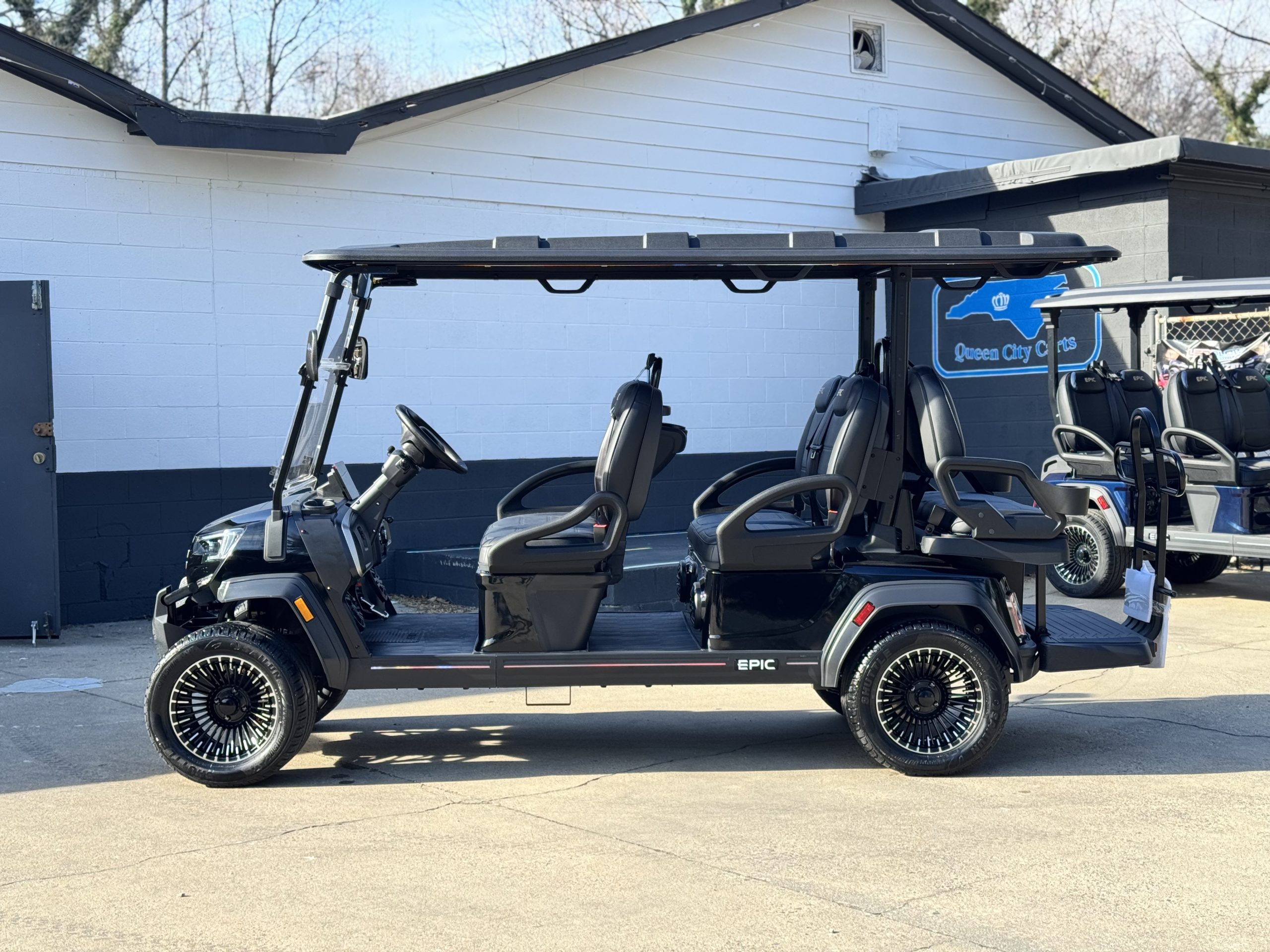
You found the perfect cart and you are ready to cruise to the lake or downtown for dinner. Then someone asks: “Do I need insurance for that?” In North Carolina, the honest answer is “it depends on how and where you drive it.” Here is a plain-English guide to golf cart insurance in NC so you can roll out of our showroom with confidence.
Golf cart insurance in NC starts with one question: golf cart or LSV?
North Carolina treats a standard golf cart and a low-speed vehicle (LSV) very differently.
- A low-speed vehicle (LSV) is built with the required safety equipment, has a VIN, and can drive on roads posted at 35 mph or less. Under N.C. General Statute 20-121.1, an LSV must be registered and insured just like any other motor vehicle.
- A standard golf cart is not titled or plated by the state. Whether it can be used on public streets is decided by your town, and many towns that allow golf carts on their streets require liability insurance as part of their permit rules.
If you are not sure which one you have, our guide to street-legal golf carts in North Carolina walks through the difference, and our LSV conversion page explains how a cart can be upgraded.
What NC requires for a registered LSV
Once your LSV gets a North Carolina plate, it falls under the same insurance rules as your car. According to NCDMV:
- You must have continuous liability insurance from a company licensed to do business in North Carolina. Out-of-state policies are not accepted.
- Proof of NC liability insurance is required before a plate is issued.
- For policies issued or renewed on or after July 1, 2025, the minimum liability limits are 50/100/50: $50,000 for bodily injury to one person, $100,000 for bodily injury to all people in one accident, and $50,000 for property damage.
- Uninsured and underinsured motorist coverage is also required.
One that surprises people every winter: your insurance company notifies NCDMV if coverage lapses, and a lapse can lead to civil penalties and loss of your plate. NCDMV specifically warns owners not to cancel insurance on a plated vehicle until the plate has been turned in, even if the vehicle is going into extended storage. So if you park your LSV for the off-season, keep the policy active unless you surrender the plate first.
Local golf cart permits: Mount Holly and Belmont examples
For standard golf carts, local rules do the heavy lifting. Two nearby examples:
- Mount Holly allows registered golf carts on certain town streets. The town code requires owners to carry liability insurance at no less than the state minimum for motor vehicles, keep proof of that insurance with them, and include proof of insurance with the permit application. If you live in or near town, our Mount Holly golf cart page has more on getting around.
- Belmont uses an annual golf cart permit, and proof of insurance is part of getting it. See our Belmont golf cart page for local tips.
Rules vary by town and change over time, and HOAs may add their own, so check your current local ordinance before driving on public streets.
Driving in South Carolina, like Lake Wylie?
If your cart lives on the South Carolina side, SC law requires proof of liability insurance to get a golf cart permit, and drivers must carry proof of that insurance while driving. LSVs in SC must be registered and carry the same insurance as other motor vehicles. South Carolina’s minimum auto liability limits are 25/50/25, plus uninsured motorist coverage at the same limits. Our South Carolina golf cart laws guide and Lake Wylie page have more details.
Will my homeowners policy cover my golf cart?
Maybe a little, but often not as much as people think. Many standard homeowners policies exclude motor vehicles, then carve out narrow exceptions for golf carts, such as use on a golf course or inside certain private communities, often with limits on speed and seating. Carts that are registered for use on public roads are commonly excluded altogether. Damage to the cart itself may only be covered if you add a special endorsement.
So call your agent and ask directly instead of assuming. If you drive on town streets, a separate golf cart or LSV policy is often the cleaner answer.
Coverage types worth asking about
The NC Department of Insurance describes these vehicle coverages:
- Liability: Pays for injuries or damage you cause to other people. It does not pay to fix your own cart.
- Uninsured and underinsured motorist: Protects you if the other driver has no insurance or not enough.
- Medical payments: Helps with medical bills for you and your passengers.
- Collision: Pays to repair your cart after an accident.
- Comprehensive (other than collision): Covers things like theft, vandalism, falling trees and flood.
- GAP coverage: If you finance, GAP can cover the difference between what you owe and what the cart is worth if it is totaled.
Two more tips. If you have upgraded to a lithium battery, lift kit, custom wheels or a premium sound system, ask your agent how added equipment is valued so it is not left out of a claim. And if you finance your cart, ask your lender what coverage they require before you sign. Our financing page explains how we make that part simple.
How Queen City Carts helps
When you shop with us at Mount Holly, Charlotte, Lake Norman or Lake Wylie, we will explain whether a cart is a standard golf cart or a street-legal LSV and walk you through the title and tag paperwork. We are not an insurance agency, so a licensed agent handles the policy itself, but we are happy to share the details your agent will ask for, like year, model, VIN, top speed and battery type.
Our go-to for golf cart and LSV insurance
When customers ask who to call, we point them to Insure Your Toy (Peter Laczko Insurance), an independent agency that offers specialty golf cart coverage. Customers tell us Insure Your Toy made it easy and the pricing was fair. When you request a quote, mention Queen City Carts.
Get a golf cart insurance quote from Insure Your Toy
Queen City Carts may receive a small referral fee from Insure Your Toy. Our recommendation is based on customer feedback.
Frequently asked questions
Do I need insurance for a golf cart in NC?
If it is a registered LSV, yes. NC requires continuous liability insurance from an NC-licensed insurer. For a standard golf cart, it depends on where you drive it. Towns like Mount Holly and Belmont require proof of insurance for their street permits.
What are the minimum insurance limits for an LSV in North Carolina?
For policies issued or renewed on or after July 1, 2025, the minimum is 50/100/50, plus uninsured and underinsured motorist coverage.
Can I cancel my LSV insurance over the winter?
NCDMV warns not to cancel insurance on a plated vehicle until the plate has been turned in, even during extended storage. A lapse can lead to penalties and losing your plate.
Does homeowners insurance cover a golf cart on the street?
Usually not. Many homeowners policies only cover golf carts in narrow situations and commonly exclude carts registered for road use. Ask your agent for the specifics of your policy.
Is a golf cart in South Carolina required to have insurance?
Yes, if you get an SC golf cart permit. Proof of liability insurance is required for the permit and must be carried while driving.
Does insurance cover a lithium battery upgrade?
It depends on your policy. Ask your agent how upgrades like lithium batteries, lift kits and custom wheels are covered and valued.
Where can I get golf cart insurance?
Start with your current auto or home agent, or a specialty insurer. Many of our customers use Insure Your Toy and tell us it was easy. Mention Queen City Carts when you request a quote.
Ready to ride, covered and confident?
Book a test drive, browse carts for sale, call us at (704) 302-1200, or check your payment in a couple of minutes. We cannot wait to get you rolling.
This article is general information, not legal or insurance advice. Laws, local ordinances and policy terms change, so confirm the details with your town and a licensed insurance agent.